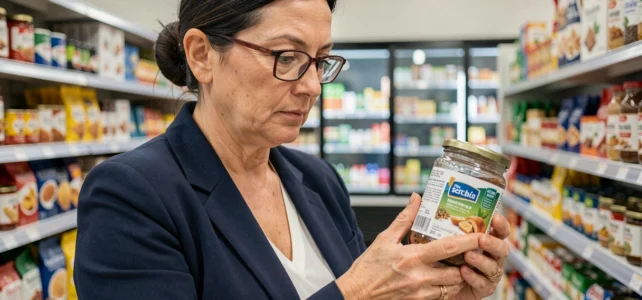
Have you ever turned an item over to read its label and found the mention “Made in EEC” without quite knowing what it means? This marking, inherited from the former European Economic Community, remains present on many products. It informs about the place of manufacture, but above all, it engages a logic of traceability that has evolved significantly since its inception. Understanding what this mention covers allows for a better assessment of the origin and quality of what we buy.
Made in EEC Marking: What This Mention Really Says About a Product
The mention “Made in EEC” indicates that a product was manufactured in a member country of the European Economic Community. Since the transformation of the EEC into the European Union, the acronym “EEC” has gradually been replaced by “EU” on new products. An item still bearing “Made in EEC” generally dates from before this transition or follows an outdated marking.
What distinguishes this type of marking from a simple marketing label is its regulatory grounding. The origin marking holds the manufacturer responsible regarding customs rules and production standards in force within the European area. It is not a voluntary certification, but an indication framed by international trade law.
In practice, for a product to display this mention, the last substantial transformation must have taken place in a member country. This is the criterion used by customs to determine origin. Buying raw materials in Asia, assembling them in Belgium or France, and then labeling them “Made in EEC” is possible, provided that the assembly constitutes a significant operation and not just simple repackaging.
When seeking to better understand the mentions made in EEC, one realizes that traceability is not limited to the final assembly country. It involves tracing back the supply chain, from raw materials to the finished product.

European Traceability and Digital Product Passport: What Changes Practically
Product traceability in Europe is entering a radically different phase. Until recently, proving the origin of a good relied on paper documents, certificates, and customs declarations. This system, still in place, shows its limits in the face of the complexity of global supply chains.
The Digital Product Passport (DPP) makes traceability mandatory and verifiable for an increasing share of goods placed on the European market. Created by the ESPR regulation, this mechanism requires manufacturers to provide structured information accessible via a QR code, an NFC chip, or a Data Matrix code.
Are you buying an electronic device or a battery? The DPP will give you access to precise data:
- The composition of the materials used and the potential presence of concerning substances, which goes far beyond simply indicating the country of manufacture
- The origin of the raw materials, the estimated durability of the product, and its reparability—criteria that the “Made in EEC” or “Made in EU” marking did not cover at all
- The environmental footprint of the product, calculated according to harmonized methods at the European level
A product without a DPP will no longer be legally sold in the EU once the applicable delegated act for its category comes into force. Batteries are the first to be affected. Other categories will gradually follow.
Why This Change Goes Beyond the Labeling Issue
The DPP transforms the relationship between consumer and manufacturer. With a simple scan, you gain access to a level of detail that even industry professionals struggled to obtain. The mention “Made in EU” remains useful, but it becomes an entry point rather than an end in itself.
For companies, the stakes are twofold. They must adapt their information systems to feed the digital passport, and they must be able to prove each declared data point. Traceability shifts from a declarative obligation to a digital proof obligation.
Product Safety and Market Surveillance: The Role of Origin Marking
Traceability is not just a matter of commercial transparency. It also serves to quickly remove a dangerous product from the market. When a good has a defect, identifying its origin and distribution chain allows for swift action.
The European Parliament has strengthened requirements in this area. The market surveillance rules aim to ensure that potentially dangerous goods are removed as quickly as possible. Information about the place of production facilitates this traceability in the event of a recall.
Without reliable origin marking, a product recall can take weeks instead of just a few days. Identifying the manufacturer, the affected batch, and the distribution channels becomes a puzzle when labels are vague or absent.

Origin Marking and Consumer Trust
The Jégo report on Made in France highlights a point applicable to all European marking: the proliferation of origin mentions (regional labels, voluntary certifications, generic claims) creates confusion. A consumer faced with “Made in EEC,” “Made in EU,” “Designed in France,” or “Origine France Garantie” does not always know what each mention entails.
The “Origine France Garantie” certification imposes a verifiable specification, unlike generic mentions like “French Tradition” that do not commit to anything specific. This distinction matters when wanting to make an informed purchase.
Reading an Origin Label: Practical Guidelines for Consumers
Rather than remembering all the regulatory subtleties, a few guidelines suffice to sort useful information on a label:
- “Made in EEC” or “Made in EU” means that the last substantial transformation took place in the European area, but says nothing about the origin of the raw materials
- A certification like “Origine France Garantie” goes further: it requires that a significant portion of the product’s value is acquired in France
- “Designed in” or “Conçu en” only concerns design, not manufacturing. A product designed in France can be entirely manufactured elsewhere
- The future digital passport (DPP) will allow access to much more complete data by scanning a QR code directly on the product
Origin marking remains a useful tool, but it only tells part of a product’s story. Ongoing regulatory developments, particularly the digital passport, will gradually bridge the gap between what the label says and what the consumer wants to know. Until then, cross-referencing the origin mention with the type of associated certification remains the most reliable method to assess the actual traceability of a good.