
On June 10, 2018, Google’s homepage transformed into an interactive vegetable garden. Instead of the usual logo, a mini-game invited visitors to catapult garden gnomes across a floral backdrop. This doodle dedicated to garden gnomes left a lasting impression well beyond its day of airing, to the point of still appearing in rankings of the best Google Doodle games several years after its release.
A garden gnome doodle that serves as a cultural study object
Several social science studies attribute to Google Doodles a cultural function that goes beyond mere entertainment. These researches analyze the Doodles as vectors of global collective memory, instruments of global cultural policy, or even objects of multimodal storytelling, capable of narrating a story by combining animation, sound, and interaction.
Applied to the garden gnome doodle, this interpretative framework changes the perspective. The mini-game does not merely entertain: it anchors in the collective digital memory a European craft tradition that originated during the Renaissance. Google chooses what it celebrates, and this choice shapes how millions of people discover or rediscover a facet of popular culture.
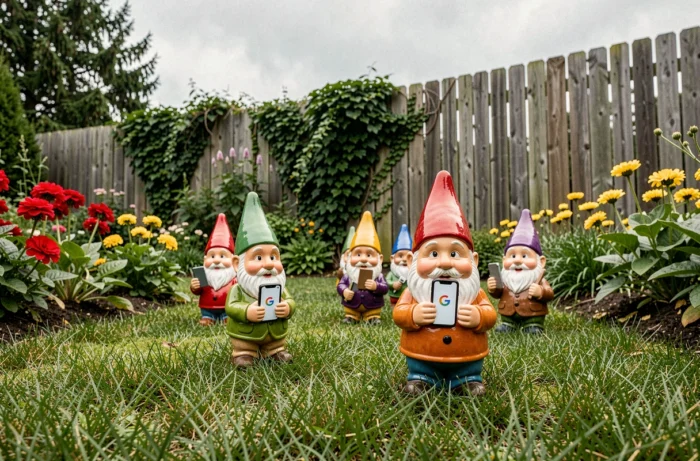
Among the interactive formats offered by Google over the years, the Google garden gnome doodle holds a special place due to its simple mechanics and quirky tone, allowing it to remain in editorial selections of online games long after 2018.
Game mechanics and catapult: why the garden gnome format worked so well
The principle is based on launching a gnome via a catapult. The player adjusts the angle, releases, and watches the figure traverse a garden dotted with flowers. The distance traveled determines the score. No tutorial, no account to create, no ads: a game lasts a few seconds and can be restarted with a click.
This minimalism partly explains the game’s longevity. The most played interactive Doodles share this characteristic: a rule understood in less than three seconds. The garden gnome takes this logic to the extreme, as the only action required is a click held down and then released.
The visual presentation also plays a role. The backdrop draws directly from traditional German imagery of the Gartenzwerg, with its bright colors and exaggerated proportions. Google tapped into the history of the garden gnome since the Renaissance to create a coherent graphic universe, incorporating references to the earliest terracotta figures that appeared in European gardens.
What distinguishes this doodle from other Google interactive games
Not all interactive Doodles are equal in terms of replayability. Some, like the anniversary Pac-Man game or cricket, require more sustained coordination. The garden gnome relies on something else: the immediate satisfaction of a successful throw and the absurdity of the situation.
Several technical elements reinforce this impression:
- The physics of the throw incorporates random bounces that make each game slightly different, even at the same angle.
- The flowers collected in flight add a layer of secondary scoring, encouraging players to restart to optimize their trajectory.
- The complete absence of penalties or game overs eliminates friction and encourages experimentation.
Google Doodle and garden gnomes: a tribute that goes beyond mere entertainment
The choice to celebrate garden gnomes is not an editorial coincidence. Google has a dedicated team, the Doodlers, who select subjects according to criteria that are rarely made public. Each Doodle reflects a cultural arbitration: highlighting one theme over another is akin to deciding what deserves the attention of billions of users for a day.
The garden gnome represents an interesting case in this logic. Unlike a tribute to a historical figure or a scientific event, it celebrates an everyday object, a popular culture artifact without academic prestige. This gap between the power of the platform and the modesty of the subject contributes to the comedic effect, but it also produces a legitimizing effect.

After the Doodle’s release, several media outlets reported on the history of garden gnomes, from the mines of Thuringia where the first figures were supposedly produced to their widespread adoption in suburban gardens around the world. Google transformed a kitsch object into a shared cultural topic on social media for several days.
The limits of a tribute driven by a private company
Academic work on Doodles also raises a question: when a company like Google decides what we collectively celebrate, who controls the narrative? Researchers note that Doodles structure cultural memory without editorial counterpower. A subject absent from the Doodles remains invisible to part of the public.
The available data does not allow for conclusions about the real impact of a Doodle on the long-term visibility of a theme. However, the case of the garden gnome shows that the viral effect of a well-designed mini-game far exceeds the day of publication. Specialized online gaming sites continue to reference and rank it among the best interactive Doodles.
The digital garden gnome in 2026: nostalgia or game design model
The longevity of the garden gnome doodle raises a question of game design. How does such a simple game remain relevant several years after its release? Two avenues emerge:
- The catapult mechanic provides immediate physical pleasure, comparable to that of mobile throwing games (like Angry Birds), without the complexity of progressive levels.
- The garden gnome theme benefits from a transgenerational appeal. Adult players find a familiar object, while younger ones discover a universe they do not spontaneously associate with the digital.
- Direct access from the Google page, without downloads or registration, eliminates all the usual barriers of video gaming.
The garden gnome doodle is probably not the most sophisticated of Google Doodles. It remains one of the most replayed, an ephemeral format by nature that has found a persistence in usage rarely observed for this type of content.