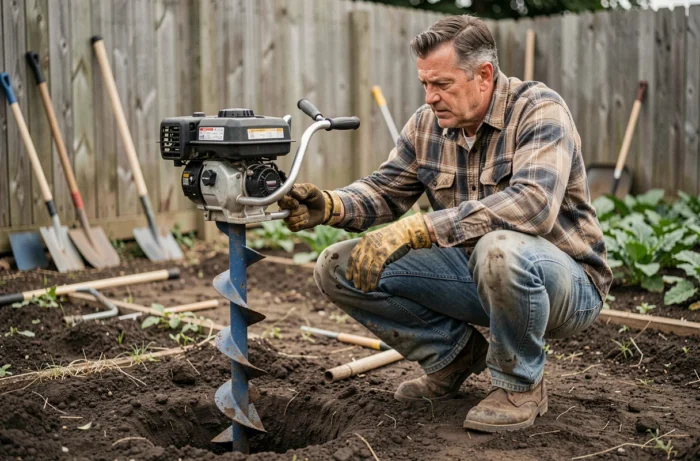
A gas-powered auger is primarily chosen based on its engine group and compatibility with the actual soil conditions of the site. The gross power alone is not enough to differentiate between two models: the type of engine, low-end torque, and the range of accepted bits determine the tool’s relevance far more than the watts displayed on the product sheet.
2-stroke or 4-stroke engine: concrete impact on torque and maintenance
In the market for gas-powered augers, nearly all consumer models feature a 2-stroke engine. This choice is explained by a favorable weight/power ratio and lower manufacturing costs. However, the torque delivered at low RPM remains limited, which hinders drilling in compact clay soils or rocky terrains.
A 4-stroke engine offers more stable torque from the first turns of the bit, which reduces jolts and the risk of blockage. The trade-off is a higher weight and more structured maintenance (oil changes, valve checks). We recommend the 4-stroke engine when the volume of holes exceeds ten per session or when the soil presents marked resistance.
The oil/gas mixture of the 2-stroke engine, if poorly dosed, accelerates cylinder fouling and degrades performance within a few hours of use. A 4-stroke engine tolerates prolonged sessions better without loss of RPM. To learn everything about gas-powered augers and refine this engine choice, the actual displacement (in cm³) remains a more reliable indicator than power in watts, which is often calculated at peak.
Compatibility of bits and diameters: the true criterion of versatility
One point that general guides often overlook: not all gas-powered augers accept the same fitting standard. Before purchasing, we systematically check the diameter of the output shaft and the type of attachment (pin, square drive, splines). An incompatibility of fittings renders the machine unusable with third-party bits.
The range of usable bit diameters directly conditions the versatility of the tool:
- Small diameter bits (less than 100 mm) are suitable for planting potted plants and light fence posts, but put little strain on the engine.
- Intermediate diameter bits (between 150 and 200 mm) cover the majority of common uses: fence posts, pergola foundations, large subject stakes.
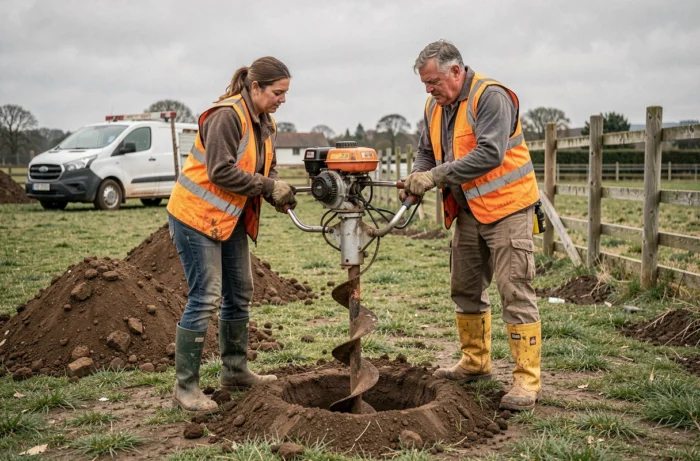
- Wide bits (beyond 250 mm) require high torque and a machine operated by two people, to avoid wrist twisting in case of blockage.
We observe that models delivered with multiple included bits often offer redundant diameters. It is better to invest in an auger that accepts a wide range and purchase separately the bits suited to your actual work.
Gas-powered augers and noise pollution: a regulatory framework not to be ignored
The noise generated by a gas-powered auger often exceeds the levels of a hedge trimmer or lawn mower. In residential areas, this parameter becomes a significant selection criterion.
Since October 1, 2023, noise from gas-powered equipment falls under the 4th class of offenses, with a fine that can reach 750 euros in the police court. French law does not set a decibel threshold for individuals: it operates on sound emergence, meaning the difference between the ambient noise of the machine running and the residual noise without it, measured at the point of disturbance.
In practical terms, a 2-stroke engine running at full speed in a suburban garden can easily exceed the tolerated emergence threshold, especially outside the time slots authorized by the municipal decree. We advise checking this decree before the work and favoring models whose manufacturers communicate a noise level in operation.
Ergonomics and safety: what separates a reliable model from a risky one
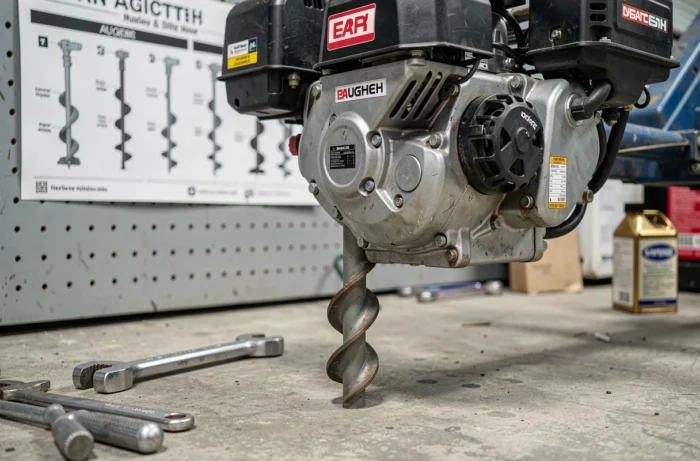
The weight of the machine, typically between ten and twenty kilograms depending on the displacement, does not tell the whole story. The distribution of mass matters more. An engine placed too high shifts the center of gravity and amplifies the torque effect in case of blockage of the bit in a root or stone.
An anti-rotation system or automatic disengagement is the only device that truly protects the operator from sudden torque backlash. Without this mechanism, the blockage of the bit instantly transmits the engine’s force to the handles. On heterogeneous soils, this risk is not theoretical.
Safety features to check before purchase:
- Presence of a centrifugal clutch that cuts transmission when the RPM drops suddenly.
- Anti-vibration handles with absorbing coating, reducing fatigue during long sessions.
- Accessible stop switch without releasing the main handle.
- Protection guard above the bit, preventing soil projections towards the operator.
Single-operator or dual-operator auger
Models with two lateral handles are designed for a single user and are suitable for small and medium diameter bits. As soon as the bit diameter exceeds 200 mm or the soil is particularly hard, a dual-operator auger with a support frame becomes necessary to control the torque without risk of injury.
The choice of a gas-powered auger boils down to three considerations: engine suited to the type of soil, actual compatibility with the bits you will need, and the presence of active safety devices. The noise level, now regulated by stricter penalties, deserves to be included in the equation from the selection phase.