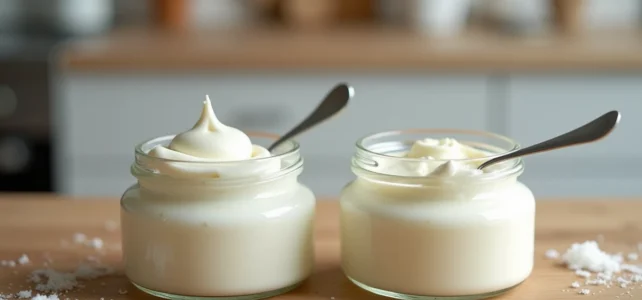
When preparing a tiramisu and hesitating between adding crème fraîche or doubling the amount of mascarpone, the final result changes completely. These two dairy products share a family resemblance, but their behavior in the kitchen diverges on very concrete points: texture, taste, reaction to heat. Understanding these differences allows you to choose the right ingredient at the right time, without ruining a preparation.
Production of mascarpone and crème fraîche: two processes, two textures
Mascarpone and thick cream are often confused because they look similar in the container. The difference lies in the production process. Mascarpone is made from heated cream that is then acidified (with lemon or white vinegar), giving it a dense, almost silky texture and a very mild taste, without marked acidity.
Crème fraîche, on the other hand, results from bacterial maturation of cream. This process gives it a slight natural acidity and a softer consistency, even in its thick version. We also distinguish between thick crème fraîche (fermented) and liquid cream (non-fermented), which do not react the same way in cooking.
To clearly understand the differences between cream with mascarpone and crème fraîche, a simple guideline can be retained: mascarpone is closer to a very fatty fresh cheese than to cream in the strict sense.
Fat content and mouthfeel
Mascarpone is generally richer in fat than crème fraîche. This difference is directly reflected in the mouth: mascarpone provides a roundness and a velvety quality that crème fraîche does not replicate. In contrast, crème fraîche offers a tangy freshness that lightens preparations.
Mascarpone in desserts: stability and poaching hold
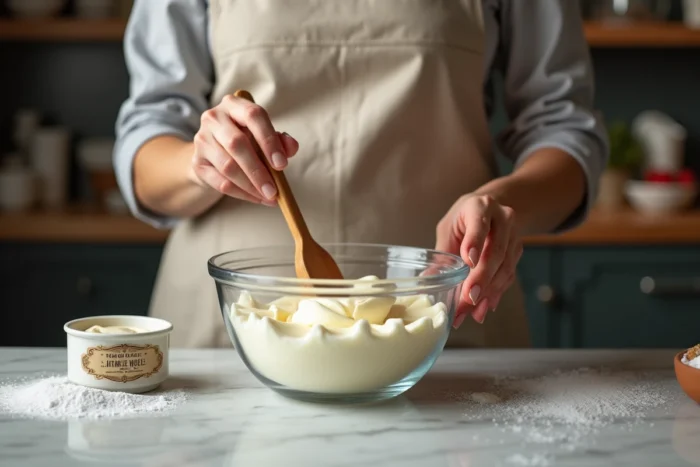
Mascarpone clearly has the upper hand in desserts. When whipping a classic whipped cream, it tends to deflate quite quickly if the cold chain is not perfect. Adding mascarpone to whipped cream stabilizes the mixture and provides much better hold, even for poaching on a cake or loaf.
The secret used by pastry chefs is based on a mechanical principle: the fat richness of mascarpone sets the structure of the whipped cream. You get a firm mousse that does not weep after two hours on a dessert.
Proportions for a mascarpone and whipped cream mixture
You do not mix the two in equal parts. The ratio that works best for a mascarpone whipped cream intended to fill a dessert or a revisited tiramisu is:
- About one third mascarpone to two thirds very cold liquid cream, whipped to firm peaks
- Mascarpone is gently folded in with a spatula into the already whipped cream, never whipped together
- Sugar and vanilla are added to the cream during whipping, not after mixing, for an even distribution
If too much mascarpone is added, the texture becomes pasty and loses its airy effect. The right dosage gives a light cream that holds without being heavy.
Crème fraîche in hot dishes: sauces, risottos, and gratins
Where mascarpone shows its limits is in prolonged heat. In a simmering sauce, it tends to curdle more easily than crème fraîche. Crème fraîche withstands long cooking better: it incorporates into juices, binds sauces, and melts in a gratin without separating.
For a risotto, a mushroom sauce, or a quiche, crème fraîche remains the most reliable choice in cooking. It adds binding and a touch of acidity that enhances savory flavors without overpowering them.
Can one replace the other in a savory dish?
You can, but the result will differ. Mascarpone in a carbonara sauce or pasta sauce gives a creamier, richer, almost coating result. Crème fraîche makes the sauce more fluid and slightly tangy. Reactions vary on this point depending on individual tastes, but the substitution is never completely neutral.
In a quick fix, thick crème fraîche can replace mascarpone in a dessert, but the result will be less firm and less sweet. To get closer to the texture of mascarpone, you can mix fresh cheese like Philadelphia with a bit of liquid cream.
Comparison table: mascarpone or crème fraîche according to the recipe
| Criterion | Mascarpone | Crème fraîche |
|---|---|---|
| Texture | Dense, velvety | Soft, more fluid |
| Taste | Mild, low acidity | Slightly tangy |
| Whipped cream stability | Excellent (in mixture) | Good, deflates faster |
| Behavior under heat | Can curdle | Stable in long cooking |
| Desserts (tiramisu, fruits, raspberries) | Ideal | Possible, less creamy |
| Savory dishes (sauce, gratin, risotto) | Possible, very rich | Ideal |
Mascarpone excels in cold desserts and fillings, while crème fraîche dominates in hot cooking and sauces.
Choosing according to the dessert: tiramisu, raspberry verrines, or chocolate cake
For a classic tiramisu, mascarpone is irreplaceable without altering the recipe. It is what gives the characteristic consistency between mousse and cream. Replacing it with crème fraîche transforms the dessert into something lighter, almost liquid.
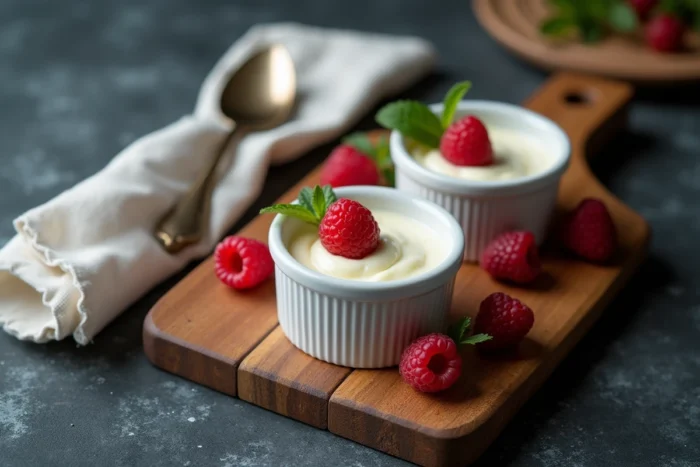
For fruit or raspberry verrines, the mascarpone and whipped cream mixture works perfectly: the cream adds lightness, and the mascarpone provides stability. You can add a speculoos-type biscuit at the bottom for crunch.
In a chocolate cake, crème fraîche integrates better into the batter as it withstands oven cooking. Mascarpone, on the other hand, finds its place in a frosting or a whipped ganache applied after baking.
- Tiramisu, no-bake cheesecake, diplomat cream: prioritize mascarpone
- Quiche, lemon-butter sauce, gratin: prioritize crème fraîche
- Decorative whipped cream or cake filling: mix both for the best stability
The choice between mascarpone and crème fraîche depends less on a question of quality than on a question of purpose. A cold dessert and a hot dish do not require the same product, and mixing the two often remains the best option to achieve both creaminess and stability.