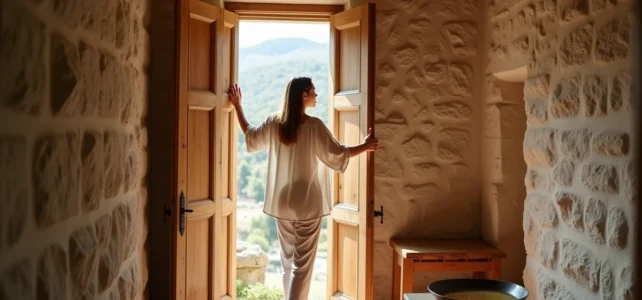
The stone stores the sun’s heat during the day and slowly releases it, including at night. This phenomenon, linked to the thermal inertia of the material, explains why a stone house can remain cool in the early morning and then become stifling in the late afternoon. Understanding this mechanism changes the way we approach indoor comfort, both during heatwaves and in winter.
Thermal inertia of stone: why indoor temperature fluctuates
Thermal inertia refers to a material’s ability to absorb, store, and then release heat. The thicker and denser a wall is, the more energy it accumulates before releasing it. Stone, granite, or limestone possess this property to a much greater degree compared to cellular concrete or wood.
In practice, this means that walls capture solar radiation for several hours. The heat slowly penetrates the thickness of the wall and reaches the interior surface with a time lag. This lag can work in favor of comfort (maintaining coolness in the morning) or against it (persistent overheating in the evening).
Knowing how to manage heat in a stone house involves acting on two distinct levers: limiting the energy that enters the walls and expelling the energy that is already there.
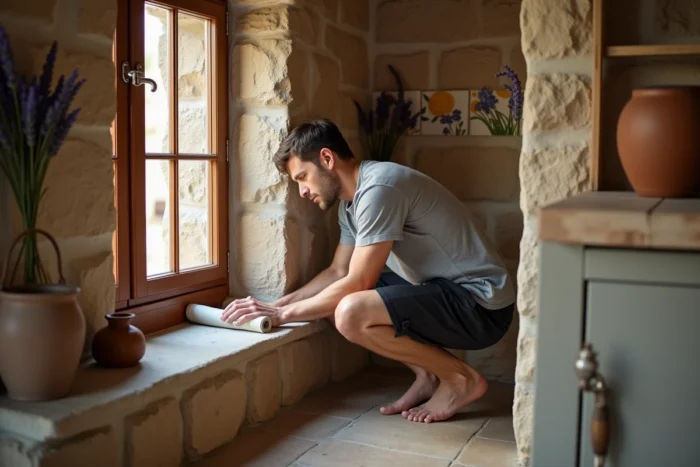
External solar protections: blocking radiation before it reaches the windows
Glazing is the main entry point for solar radiation into a home. An interior curtain stops visible light but allows some infrared energy, already trapped in the room, to pass through. The most effective protection is therefore placed outside the window, before the sun can penetrate the glass.
Shutters, blinds, and vegetation
Solid wooden shutters, common on old stone houses, remain the most radical option. Closed two-thirds on south and west-facing facades between late morning and early evening, they block nearly all direct solar radiation.
Projection blinds (also known as Italian blinds) offer a compromise: they deflect the sun while allowing diffuse light and some airflow to pass through. For south-facing facades, a deciduous plant trellis serves a similar role, with the advantage of letting the sun through in winter when the leaves have fallen.
- South facade: half-closed shutters or deciduous plant trellis, to be combined with an eave if the configuration allows.
- West facade: closed solid shutters from midday, as the low afternoon sun directly hits the glazing.
- East facade: useful protection only in summer mornings, often mistakenly neglected during heatwaves.
Nocturnal ventilation and over-ventilation: expelling stored heat from the walls
When the outside temperature drops at night, opening windows creates a draft that cools both the ambient air and the interior surface of the walls. This is nocturnal over-ventilation, the logical complement to daytime solar protection.
For a draft to flow through the home, there must be at least two openings located on opposite facades or at different heights. Warm air rises: a roof window or a skylight upstairs, combined with an opening on the ground floor, accelerates natural airflow.
The right timing for ventilation
Opening too early in the evening is counterproductive if the outside temperature is still higher than the inside. A reliable signal: place your hand on the exterior wall of the shaded facade. If it is cooler than the interior wall, ventilation will be beneficial. Closing windows and shutters as soon as the sun rises helps to retain the coolness accumulated during the night.
Thermal insulation of a stone house: acting without trapping moisture
Interior insulation, often considered first, poses a specific problem for stone: it traps moisture between the insulation and the wall. Stone breathes, meaning it allows water vapor to migrate. An impermeable insulation (such as polystyrene) cuts off this migration and promotes condensation, mold, and even wall degradation over time.
Two approaches limit this risk:
- Choosing an insulation with high vapor permeability (wood fiber, hemp wool, lime insulating plaster) that allows the wall to dry inward.
- Prioritizing external thermal insulation when the architectural character of the facade allows it, as it maintains the wall’s inertia on the interior side while reducing heat loss.
- Treating thermal bridges at windows, lintels, and floor-wall junctions, which are often more significant than the wall’s surface area.
In winter, the inertia of stone becomes an asset: once the wall is warmed, it releases heat steadily. Insulation does not eliminate this property; it reduces losses to the outside and stabilizes the indoor temperature throughout the day.
Limiting the use of air conditioning during heatwaves
An air conditioner addresses the symptom (too hot air) without tackling the cause (solar radiation and heat accumulated in the walls). In a stone house, the combination of solar protection and nocturnal ventilation covers most summer situations without electrical consumption.
When a heatwave settles in for several days and nighttime temperatures do not drop enough, a fan (ceiling or standing) speeds up the evaporation of sweat and improves comfort without cooling the air. Air conditioning should then only be used as a last resort, ideally limited to a single retreat room, with doors closed, to avoid cooling a stone volume that will absorb and release cold ineffectively.
A properly sized external blind, shutters operated at the right time, and cross-ventilation at night are sufficient to maintain a notable temperature difference between the inside and outside. Stone, often seen as a handicap in summer, then becomes a passive thermal regulator that works both ways depending on the season.