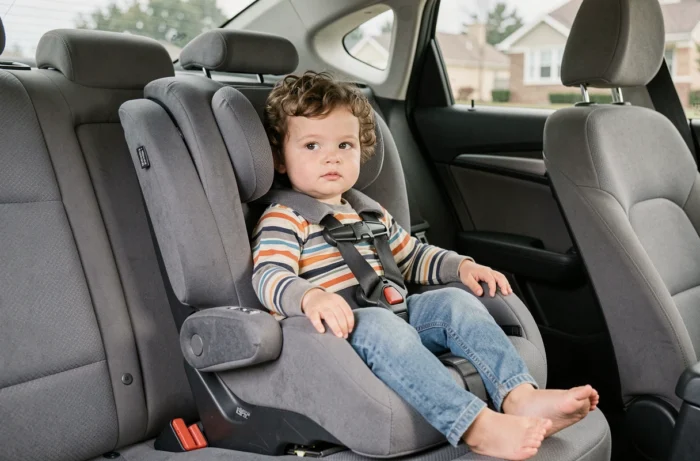
A group 1/2/3 car seat covers a usage range from about 9 kg to 36 kg, or from 9 months to around ten years depending on the child’s build. For a 2-year-old, this type of seat often represents the first evolving equipment after the infant carrier. The choice relies less on the brand than on the actual compatibility between the child’s size, the vehicle, and the seat’s approval standard.
Why height takes precedence over weight for a car seat at 2 years
The old classification by weight groups (R44) structured the market for years. Parents reasoned in kilograms: group 1 from 9 to 18 kg, group 2 from 15 to 25 kg, group 3 from 22 to 36 kg. This logic is fading away.
Since September 1, 2024, only UN R129 (i-Size) approved seats can be sold new in the European Union. The R129 standard classifies seats by height ranges, not weight. An evolving seat covering the old “group 1/2/3” now displays a range like 76-150 cm.
For a 2-year-old, the average height is around 85-90 cm. Choosing the group 1 2 3 car seat for a 2-year-old by first checking their height (and not just weight) ensures that the harness, headrest, and side protections are positioned at the correct level. A seat that is too large leaves slack in the harness, while a seat already at the lower height limit reduces the duration of use.
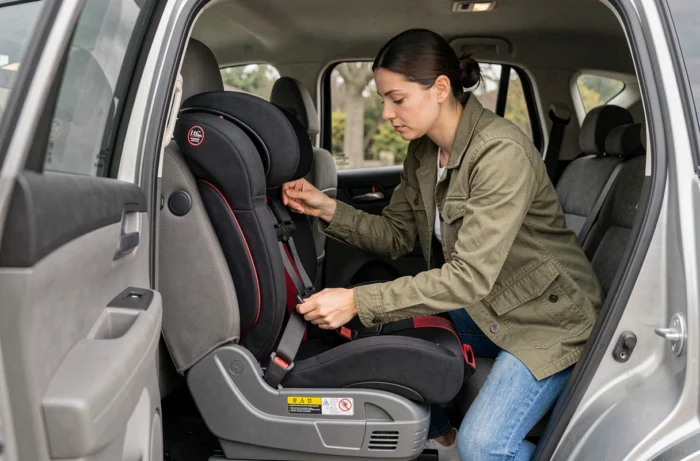
Five-point harness or shield: two restraint systems to distinguish
At 2 years old, the child is secured in the seat by a five-point internal harness or by an impact shield placed in front of the abdomen. These two systems do not offer the same daily experience or the same constraints in the event of a collision.
The five-point harness secures the child at the shoulders, hips, and between the legs. It keeps the torso pressed against the backrest, which limits the forward movement of the head during a frontal impact. The adjustment should be tight enough that only one finger can fit between the strap and the child’s collarbone.
The impact shield distributes the energy of the impact over a larger area (abdomen and thighs). Some children tolerate it better than the harness, while others push it away as soon as they have the strength to lift it. The shield is generally removed when the child reaches about 100 cm, and the seat then transitions to booster mode with the vehicle’s seatbelt.
What changes concretely in daily life
- With a harness, installation takes a few extra seconds (tightening the straps for each trip), but the child cannot unbuckle themselves.
- With a shield, installation is quick (you place the shield and pass the seatbelt), but some children refuse the shield as early as 2-3 years, which can make trips difficult.
- The transition to “big child” mode (seatbelt only) is more gradual with a harness: you remove the harness when the child reaches the maximum height indicated by the manufacturer, then use the vehicle’s seatbelt guided by the seat’s headrest.
Isofix attachment and vehicle compatibility: check before buying
Almost all group 1/2/3 seats sold today are installed via the Isofix system, two metal anchor points located between the seat base and the backrest of the rear bench. A third fixation point (Top Tether or support leg) stabilizes the seat against tipping forward.
A common pitfall: not all vehicles have Top Tether on all rear seats. The center seat, when it exists, is rarely Isofix compatible. Checking the compatibility list provided by the seat manufacturer (often available on their website) avoids a return after purchase.
Used R44 seats: what you need to know
R44 approved seats remain legal for use, but they can no longer be sold new since September 2024. A used R44 seat may be suitable if its approval label is intact, it has not been in any accidents, and the straps show no fraying or deformation. In the absence of these guarantees, the seat must be discarded, regardless of its price.
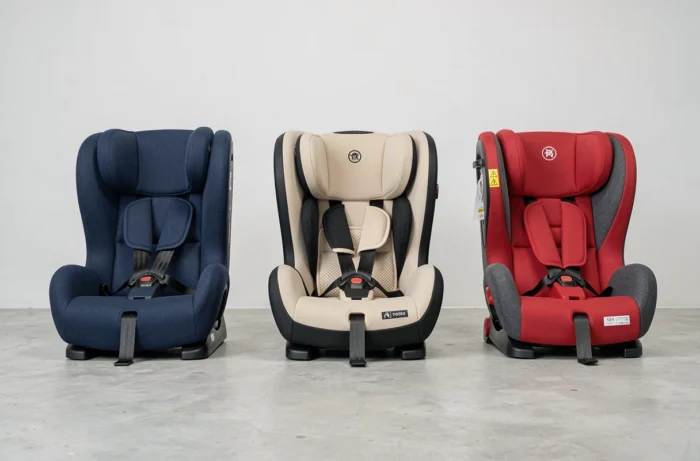
Group 1/2/3 car seat: three criteria for effective selection
The market offers dozens of models ranging from a hundred to several hundred euros. Three criteria allow for quickly eliminating unsuitable options.
The first is the actual height range covered by the harness. Some seats 76-150 cm switch to seatbelt mode as early as 100 cm, while others maintain the harness up to 105 cm. For a 2-year-old, these few centimeters represent an additional one to two years of use with the harness, which is preferable in terms of support.
The second criterion concerns the depth of the seat and the width between the side protections. A 2-year-old has a very different build from a 6-year-old. A seat that is too wide for a small build allows the head to sway sideways. The reducer cushions provided with the seat partially compensate for this flaw, but their thickness varies greatly from one manufacturer to another.
The third criterion is the inclination of the backrest. At 2 years old, car naps are frequent. A seat that offers several reclining positions (usually three to four) prevents the head of a sleeping child from tipping forward. Not all models offer this feature in harness mode.
Rear-facing after 2 years: an option still underestimated
The R129 standard requires rear-facing until at least 15 months, but European testing organizations recommend extending this position as long as possible. Some group 1/2/3 seats allow rear-facing installation up to about 105 cm, which corresponds to a child of around 4 years.
At 2 years old, a child installed rear-facing benefits from significantly superior protection in the event of a frontal collision, the most common type of impact. The forces are distributed across the entire back rather than concentrated on the neck. If the vehicle and seat allow it, this configuration remains the most protective at this age.
The main drawback is legroom: in a compact vehicle, the rear-facing seat in group 1 position may touch the back of the front passenger seat. Checking the available space before purchase remains the only reliable method, as the dimensions advertised by manufacturers do not account for the variety of interiors.
The choice of a group 1/2/3 car seat for a 2-year-old hinges on measurable technical details: harness height range, vehicle Isofix compatibility, seat depth suitable for the current build. A well-fitted seat today, installed correctly, offers better protection than a high-end model poorly positioned.